
The AI Cheating Panic is Missing the Point
What I am seeing in classrooms right now and why this shift may be necessary

AI did not suddenly create cheating in schools.
It made something visible that has been there for a long time.
Introduction
A recent piece from The New York Times highlights what many educators are already experiencing. Students are using AI tools to complete homework, assist with writing, and, in some cases, generate full assignments. Schools are struggling to respond. Policies are unclear. Enforcement is inconsistent.
None of that is surprising.
What matters more is what sits underneath it.
What the article gets right
The reporting captures a real shift:
AI tools are now part of students’ everyday academic workflow
Homework is becoming harder to trust as evidence of learning
Teachers are adjusting, often without clear guidance
This is not theoretical. It is happening across classrooms right now.
Where the conversation is still too shallow
Most coverage, including this article, frames the issue as cheating.
That framing is incomplete.
Students have always found ways to complete assignments with minimal effort when those assignments feel disconnected from real learning. What AI has done is remove the friction. It is faster, easier, and more accessible than anything that came before.
The deeper issue is this:
If a student can hand a task to a machine and receive a complete answer, what exactly are we asking them to learn?
This does not mean academic integrity no longer matters. It means we need to redefine it in a way that reflects how students actually learn in an AI-supported environment.
That question is not about discipline. It is about design.
What I am seeing in my own school
This shift is not abstract.
In my own school, I am seeing teachers respond in real time. Not through formal policy changes, but through everyday classroom decisions.
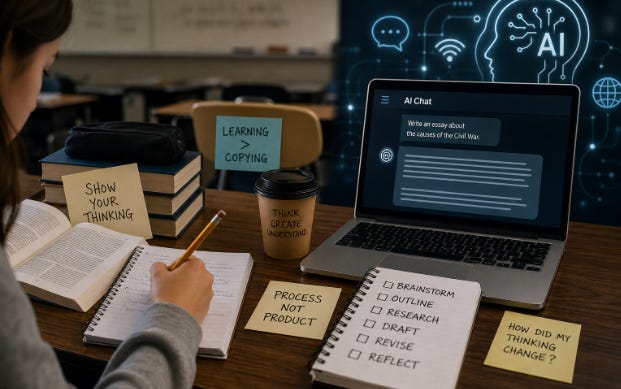
Assignments are being redesigned. More work is happening in class. There is a growing emphasis on process, not just final product.
There is also a quieter realization taking hold.
Traditional homework, as it has been structured for years, is no longer a reliable measure of learning.
Students are not confused about what is happening. They know these tools exist, they know adults are using them too, and they are trying to navigate expectations that are still being defined.
At the same time, many educators are using AI to plan lessons, generate materials, and streamline their work. That tension is real, and it is forcing more honest conversations about what counts as learning.
What this means for classrooms right now
This is where the conversation needs to move.
Not toward stricter detection, but toward clearer purpose.
A few shifts are already emerging:
Work completed entirely at home is losing credibility as an assessment
In-class thinking, discussion, and writing are becoming more central
The process of learning is being valued more explicitly than the final answer
Access to AI tools is unequal, which means that how we design assignments now has real implications for equity across classrooms and communities.
This does not mean abandoning homework entirely.
It means being honest about what it can and cannot show us.
This shift is not the problem
For many educators, this moment feels like a loss of control.
But there is another way to read it.
For far too long, we have been assigning work that could be completed without deep thinking. Tasks built around compliance, repetition, or surface-level responses were always vulnerable. AI did not create that vulnerability. It revealed it.
In that sense, this shift is not entirely negative.
It is forcing us to ask harder questions:
What does it mean to actually understand something?
What kinds of tasks require original thought?
What are we really assessing when we grade student work?
If AI can do the assignment, the assignment needs to change.
This is the moment to rethink, not retreat.
Paywall Preview
If AI can do the assignment, the assignment needs to change.
The question is not how to catch students using AI.
The question is how to design learning experiences where thinking cannot be outsourced.
Below are practical ways to start doing that now.
