
The ChatGPT Study Everyone Shared Was Retracted
What educators and librarians need to understand about AI research, hype, and information literacy right now

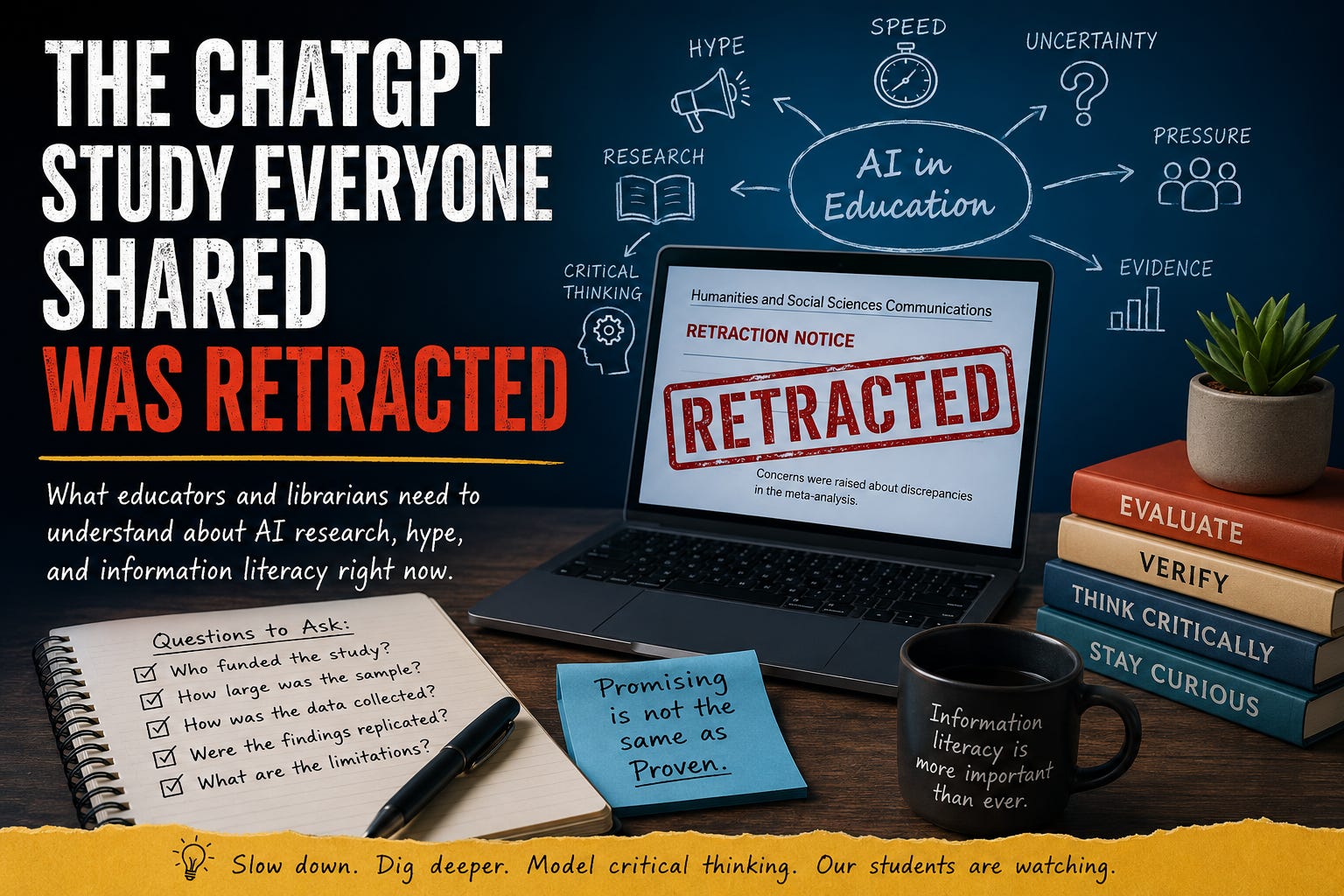
A few days ago, a widely shared study claiming that ChatGPT significantly improved student learning outcomes was officially retracted.
And honestly, that should concern all of us.
Not because it proves AI has no place in education. It does not. Not because all AI research is unreliable. It is not. But because this entire situation reveals something much larger about how quickly educational conversations are moving, how fragile the current AI evidence ecosystem really is, and how often schools are being pushed to make decisions before the research has had time to mature.
And before I go any further, I should probably acknowledge something uncomfortable. I may have even shared this study myself at some point. Honestly, I do not know for certain if I did or did not. But considering how widely it circulated across education and AI spaces, there is a good chance I referenced it somewhere along the way.
That realization has honestly been sitting with me a little uncomfortably this week. Because I spend a huge amount of my professional life teaching information literacy, media literacy, and source evaluation. I teach students and educators to slow down, verify claims, and think critically about information ecosystems. Yet even with that background, I still found myself wondering whether I had amplified this study simply because it seemed credible and was being discussed everywhere.
And I think that is part of why this story matters so much. This is not really a story about one irresponsible researcher or one educator accidentally sharing misinformation online. This is a story about speed. The speed of the AI conversation. The speed of academic publishing. The speed of social media amplification. And the speed at which studies become accepted truth before enough scrutiny has happened.
Honestly, part of what unsettles me most is not that the study was retracted. It is how unsurprising it felt once I stepped back and looked at the larger ecosystem surrounding AI in education right now.
What Happened
The paper, published in Humanities and Social Sciences Communications, had quickly become one of the most cited studies supporting the use of ChatGPT in education. It was shared widely across social media, referenced in presentations, included in discussions about AI policy, and treated by many as strong evidence that generative AI tools improve learning outcomes.
Then it was retracted.
According to the journal, concerns were raised about “discrepancies in the meta-analysis” significant enough to undermine confidence in the findings. The retraction itself was relatively restrained in tone, but the implications are not small. By the time the paper was withdrawn, the conclusions had already spread almost everywhere.
By that point, the study had already been cited hundreds of times and discussed widely across education and AI spaces. That matters because once a study becomes embedded into conference presentations, policy conversations, vendor marketing, newsletters, professional development, and social media discussions, the original claim often continues circulating long after corrections appear.
And once information becomes embedded into public conversations, professional development sessions, district presentations, conference slides, and social media posts, it becomes very difficult to pull back. Retractions almost never travel as far as the original headline.
The Pace of AI Is Outrunning the Pace of Evidence
The original study analyzed dozens of AI education studies published between late 2022 and early 2025. On the surface, that sounds impressive. But step back for a moment and think about how compressed that timeline really is.
ChatGPT was publicly released in November 2022. We are barely a few years into widespread classroom experimentation with generative AI, yet schools, companies, consultants, policymakers, and media outlets are already searching for definitive answers about long-term educational impact. That creates enormous pressure on researchers to produce findings quickly. It also creates enormous pressure on educators to interpret research before the field has stabilized.
And to be clear, I am saying this as someone who actively works in AI education spaces. I speak at conferences about AI. I write about AI constantly. I help educators think through how these tools are changing research, teaching, and information literacy. I believe schools need to engage seriously with AI because students are already living in an AI-shaped world.
But that is exactly why this moment concerns me.
Because I also see how quickly weak evidence, preliminary findings, and oversimplified claims can become embedded into professional development, district conversations, conference sessions, and social media discourse before enough scrutiny has happened. There is enormous professional pressure right now to have strong opinions about AI very quickly. Schools want implementation plans. Educators want guidance. Parents want reassurance. Companies want adoption. Conference audiences want answers. And social media rewards confidence far more than caution.
I also think many educators are simply overwhelmed. The tools keep changing, the studies keep coming, the headlines keep escalating, and schools are being asked to make high-stakes decisions in the middle of enormous uncertainty.
Meanwhile, students are watching adults navigate all of this in real time. They are seeing educators, researchers, influencers, journalists, and technology companies all making competing claims about what AI means for learning. That makes information literacy no longer just a student skill. It has become an institutional survival skill for schools themselves.
Sometimes Schools Are Searching for Reassurance, Not Evidence
I also think there is another uncomfortable reality underneath all of this. Sometimes, what schools are really searching for is not evidence. It is reassurance.
Reassurance that adopting AI quickly is the right decision. Reassurance that banning AI entirely is the right decision. Reassurance that someone, somewhere, has already figured this all out.
But education rarely works that neatly, especially during moments of technological disruption.
The public conversation around AI in education often swings wildly between extremes. One side insists AI will revolutionize learning and solve long-standing educational problems. The other insists AI should be banned outright and has no legitimate educational value. Neither position reflects the complexity educators are actually dealing with in schools.
One of the biggest problems in AI education conversations right now is that “promising” often gets translated into “proven” far too quickly. Early findings can absolutely be valuable. Pilot programs can reveal important possibilities. Small studies can identify areas worth exploring. But that is very different from claiming we have settled evidence about long-term educational outcomes.
The reality is that some AI tools may genuinely support learning in certain contexts. Others may increase dependency, reduce critical thinking, widen inequities, or create new ethical concerns. And in many cases, we simply do not have enough mature evidence yet to make sweeping claims either way.
Librarians Have Seen This Before
In some ways, librarians and educators have seen versions of this before. Search engines were going to destroy research. Wikipedia was going to end academic rigor. Learning styles became deeply embedded into educational conversations long before the evidence supporting them was clear.
Education technology has always been vulnerable to cycles of hype, panic, oversimplification, and premature certainty. What feels different now is the speed.
Researchers are publishing rapidly. Companies are marketing aggressively. Media outlets are racing to cover every new study. Social media platforms reward certainty and simplicity, not nuance and methodological caution.
The problem is not that educators are talking about AI too much. The problem is that the systems producing, amplifying, monetizing, and debating AI research are all moving faster than the normal processes that help knowledge stabilize.
This Is Ultimately an Information Literacy Story
What makes this especially important for educators and librarians is that this is fundamentally an information literacy story. It is about authority. It is about verification. It is about understanding how research evolves over time. And it is about recognizing that “peer reviewed” does not mean “beyond criticism.”
In many ways, this mirrors the exact skills we already try to teach students every day. Check the source. Look for corroboration. Understand context. Ask who benefits from a particular narrative. Recognize that knowledge changes as new evidence emerges.
The challenge now is that educators themselves are being forced to navigate an information environment moving at unprecedented speed. And AI is accelerating that pressure everywhere.
What Educators Should Be Asking
Educators do not need to become statisticians. But we do need to become more comfortable asking harder questions when new AI studies appear.
How large was the sample size? How long was the study conducted? Who funded it? Was the effect meaningful or merely statistically significant? Were the studies in a meta-analysis actually comparable? Has the research been replicated? What limitations did the authors acknowledge?
And perhaps most importantly, is this being presented as promising evidence, or as settled evidence? Because those are not the same thing.
Final Thoughts
I do not think the lesson here is that educators should stop reading AI research. And I do not think the lesson is that schools should avoid engaging with AI altogether. Students are already living in an AI-shaped world. Schools cannot pretend otherwise.
But I do think this moment calls for more humility. More patience. More willingness to say, “We do not know yet.”
Because students are watching how adults respond to uncertainty. They are watching how we evaluate evidence. They are watching whether we change our minds when new information emerges.
And honestly, that may be one of the most important forms of AI literacy we can model right now.
Read More
Ars Technica, “Influential study touting ChatGPT in education retracted over red flags”
Read it here: https://arstechnica.com/ai/2026/05/influential-study-touting-chatgpt-in-education-retracted-over-red-flags/Nature Retraction Notice
Read it here: https://www.nature.com/articles/s41599-026-07310-z404 Media, “Nature Retracts Paper on the Benefits of ChatGPT in Education”
Read it here: https://www.404media.co/nature-retracts-paper-on-the-benefits-of-chatgpt-in-education/TechSpot, “Major ChatGPT education study retracted after flaws found”
Read it here: https://www.techspot.com/news/112303-major-chatgpt-education-study-retracted-after-flaws-found.htmlThe Verge, “AI-generated research papers are overwhelming scientific peer review”
Read it here: https://www.theverge.com/ai-artificial-intelligence/930522/ai-research-papers-slop-peer-review-problem